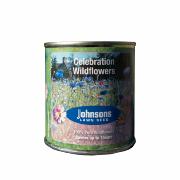
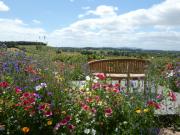
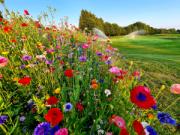
Our Celebration flower mixture contains a carefully selected blend of native & non-native wildflowers. Celebration is all about colour, variety and ease of use. Each tin contains a balanced blend of annual species chosen to complement one another in height, form and flowering time.
Wildflower Species Included
Paper Daisy (Helipterum roseum)
Long-lasting, papery blooms in white, pink, and purple shades that add texture and colour. Ideal for fresh or dried displays.
- Colours: Pink/White/Purple
- Height: 40-60cm
- Flowering: June-September
Pheasant’s Eye (Adonis annua)
A striking traditional wildflower with rich red to orange petals and dark centres, providing bold early-season colour.
- Colours: Red/Orange
- Native to the UK
- Height: 20-40cm
- Flowering: May-July
Pot Marigold (Calendula officinalis)
Bright, cheerful flowers in warm red, orange, and yellow tones that bloom freely and are highly attractive to pollinators.
- Colours: Red/Orange/Yellow
- Not traditionally native but present in UK for centuries
- Height: 30-60cm
- Flowering: June-October
Cornflower (Centaurea cyanus)
A classic meadow annual producing nectar-rich blooms in blue, pink, and white, loved by bees and butterflies.
- Colours: Blue/Pink/Purple
- Native to the UK
- Height: 40-90cm
- Flowering: June-August
Cosmos (Cosmos bipinnatus)
Tall, airy plants with daisy-like pink and purple flowers that flower continuously and draw in pollinating insects.
- Colours: Pink/Purple
- Height: 60-120cm
- Flowering: July-October
Painted Daisy (Chrysanthemum carinatum)
Vivid, multi-toned flowers in red, orange, pink, and yellow, adding strong colour contrast and a cottage-garden feel.
- Colours: Red/Orange/Pink/Yellow
- Height: 30-60cm
- Flowering: June-August
Dwarf Morning Glory (Convolvulus tricolor)
A compact annual with trumpet-shaped flowers in blue, purple, pink, and white that open fully in sunshine.
- Colours: Blue/Purple/Pink/White
- Height: 20-30cm
- Flowering: June-September
Chinese Forget-me-not (Cynoglossum amabile)
Fine sprays of soft blue flowers that add lightness and fill gaps within the display.
- Colours: Blue
- Height: 30-60cm
- Flowering: June-August
California Poppy (Eschscholzia californica)
Silky, cup-shaped flowers in a multi-colour mix, thriving in dry conditions and flowering prolifically.
- Colours: Multi-Coloured Mix
- Height: 20-40cm
- Flowering: June-September
Fineflower (Phacelia tanacetifolia)
Delicate blue and pink blooms carried on slender stems, highly attractive to bees and beneficial insects.
- Colours: Blue/Pink
- Height: 40-80cm
- Flowering: June-August
Farewell to Spring (Clarkia amoena)
Elegant star-shaped flowers in pink, red, and white that flower over a long period and complement bolder species.
- Colours: Pink/Red/White
- Height: 30-60cm
- Flowering: June-September
Baby’s Breath (Gypsophila elegans)
Light, airy sprays of small red and white flowers that soften the mix and provide excellent contrast.
- Colours: Red/White
- Height: 30-50cm
- Flowering: June-August
Candytuft (Iberis umbellata)
Low-growing plants with dense clusters of flowers in white, blue, pink, and purple, ideal for edging and early colour.
- Colours: White/Blue/Pink/Purple
- Height: 20-40cm
- Flowering: May-July
Corn Poppy (Papaver rhoeas)
An iconic wildflower with vivid red blooms that create dramatic impact and provide valuable pollen for insects.
- Colours: Red
- Native to the UK
- Height: 40-70cm
- Flowering: June-July
Love-in-a-Mist (Nigella damascena)
Distinctive flowers in blue, pink, purple, and white, surrounded by feathery foliage and followed by decorative seed pods.
- Colours: White/Blue/Pink/Purple
- Height: 30-50cm
- Flowering: June-August
Suitable for sowing in specific garden borders or to create a wildflower meadow
Apply in Spring (March–May) or Autumn (September–October). Flowering will be from May to the first frosts - if sowing in autumn, flowers will not appear until following year.
Where to use Celebration
How to sow
How to sow a wildflower meadow
For the best visual impact we recommend ensuring you start from a fresh clean soil base and sow at the recommended rate. This allows wildflowers to establish successfully without being outcompeted by grasses and unwanted weeds.
Common mistakes
- Planting plugs during very dry or hot weather.
-
Mowing too soon after planting.
-
Adding fertiliser or rich compost to lawns (discourages wildflowers).
-
Planting too shallow or too deep.
-
Overcrowding – allow space for natural spreading.